
Contemporary Masculinity & Swiss Army Man (2016)
- Laura M
- Dec 15, 2025
- 4 min read

In Swiss Army Man (2016), the relationship between Hank and Manny externalizes a fractured, contemporary masculine identity struggling between social conditioning and liberation. Where Hank embodies the version of masculinity that is shaped by shame, fear, and the compulsory roles of heterosexuality, Manny represents an ‘unsocialized’ masculinity, where his essence is ‘pure’, innocent, and defined by curiosity, desire, and unfiltered emotional expression.
By examining three scenes, the underwater kiss during the bridge fall, the bear
confrontation, and the final beach scene where society witnesses Hank’s loyalty to Manny, we can see how the film uses formal techniques to depict the struggle between conditioned
masculinity and the liberated masculine self.
Scene 1 - Underwater Kiss
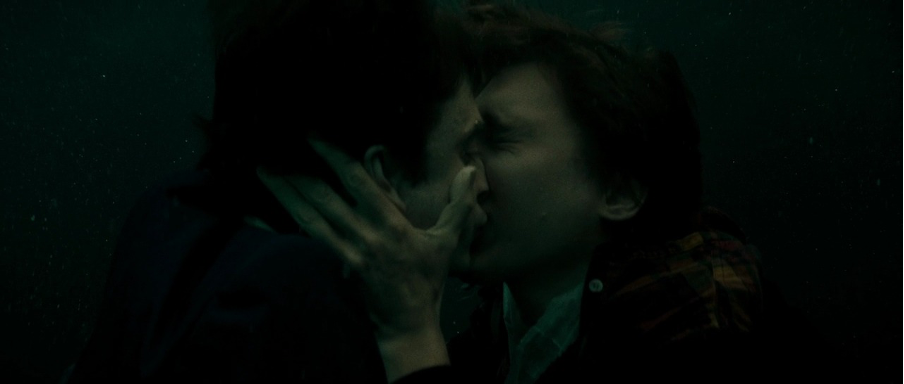
The underwater kiss sequence marks the film’s first union between Hank and Manny, visually
expressing a moment where the boundaries between the conditioned and liberated masculinity dissolve. The sequence begins when the pair fall from the bridge and into the river. Manny starts to sink to the bottom, where Hank is captured rising to the surface, until he goes back to save Manny, where he manages to grab him, and breathe life back into him with a kiss.
Formally, the scene progresses with rapid intercuts of a blurry vision of Manny passionately
grabbing Hank’s hand, and Hank reaching back for Manny’s face, both in the vision and
underwater accompanied by quick tempo and whaled sirens, until they finally kiss, and time
slows. The use of slow motion, soft, diffused lighting, and a sacred hum with ambient
underwater noise creates a suspended, dreamlike atmosphere. The camera lingers in a fluid
tracking movement, going from a close-up to a medium shot, emphasizing the weightlessness of their bodies, creating this ethereal state of them being the only ones in the world. The shot is low in contrast, depicting their full integration, enveloped, protected by water. This aesthetic lightness is sharply distinct from the rougher realism of the scenes that precede it, signaling the shift from Hank’s fear-driven survivalist mindset into full surrender.
The kiss itself, although ambiguous, functions as a visual metaphor for integration. It is in the
water, removed from the world and its demands of heteronormative demands, that Hank
experiences a moment of vulnerability and Manny comes fully alive. Water becomes a site of
safety, a space where masculine identity is not audited, but dissolves. The underwater
sequence introduces a central dynamic in the film; Manny “usefulness” thrives wherever Hank abandons masculinity’s learned constraints.
Scene 2 - Bear Attack

Where the underwater kiss represents masculine integration, the bear confrontation marks the film’s moment of rupture, where Hank abruptly reinstates the very social scripts that once
suffocated him. When Hank tells Manny, “She’s my Sarah, not yours,” the scene’s formal
qualities shift dramatically: the editing becomes noticeably faster, handheld camera movement replaces the earlier sense of visual stability, and the lighting shifts to a harsher, darker palette.
The diegetic sound grows tense and irregular, creating a sound landscape that feels volatile.
Manny’s previously reliable abilities falter, his “powers” fail at first, and his vitality dims. The film directly binds Manny’s capacities to Hank’s capacity for vulnerability and intimacy, once Hank reasserts patriarchal ownership and heterosexual competition, Manny collapses.
This moment visualizes the harm that occurs when a man falls back into conditioned
masculinity. The imaginative world the two created together, soft, unrestricted, queer, and
emotionally expansive, cannot survive once Hank re-establishes the insecurities that structured his former self. The shift from floaty, dreamlike mise-en-scène to a more grounded and fractured visual composition signifies the return of survivalist, normative social pressures. These pressures are formally reframed not just as contextual but as actively destructive. They constrict the space in which Manny’s liberated masculine energy can function. Manny thrives only in a relational environment free from shame and fear, yet as soon as shame resurfaces, that liberated energy shuts down. The scene’s formal texture conveys this collapse with clarity.
Scene 3 - Final Beach Scene

The final beach frame cements the film’s exploration of masculine integration. Hank and Manny, positioned in the distant background, are held in focus, while the crowd, representing social life (family, police, media) occupies the foreground as an confronting, yet meaningless
omnipresence. This compositional choice visually encodes a reclaim of power. Society’s
policing gaze is present, yet Manny and Hank’s liberated presence is affirmed, despite being
visually oppressed. This is the moment where Hank surrenders, and liberates himself from the eyes of societal norms.
Water returns as a motif in the mise-en-scene, representing this sacred, pure space of truth.
Manny’s body, carried back toward the ocean, initiates a final act of refusal against
heteronormative, masculine constraints. When he farts and propels himself into the waves, the score reprises its peaceful hum, and the camera lingers in a wide shot that allows Manny’s departure to dominate the frame. This indicates that the liberated masculine self cannot be contained by heteronormative expectations. Followed by a close-up of Hank’s expression, reveals his acceptance with Manny leaving, as though they have finally aligned.
Formally, the scene dramatizes the test of integration. Can Hank remain connected to his
liberated self in the presence of the very social institutions that once conditioned his identity?
The film answers by visually privileging Manny’s ecstatic movement as climactic, without ever
once acknowledging the presence of the crowd, reaffirming the film’s queer reimagining of
masculinity.
Comments